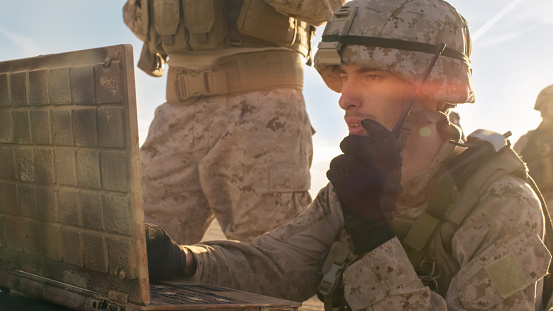
Across domains, agencies are doubling down on investments that enhance military systems’ agility, security and interoperability. Looking ahead to 2026, several key trends are emerging as clear priorities for modern mission readiness.
These trends are backed by policy, procurement and active development across the U.S. Department of War, its partners and forward-leaning defense integrators. Here are five mission-driven technologies set to shape the next era of defense innovation.
1. AI-Augmented Decision Making
Artificial Intelligence and Machine Learning (AI/ML) are powering back-office analytics while also being deployed closer to the fight. From predictive maintenance to target recognition to autonomous mission planning, AI is increasingly embedded into field-deployable systems.
What’s changing in 2026:
- Edge AI is becoming standard. Processing happens locally on rugged, power-conscious systems, not just in the cloud.
- Multi-domain decision support: AI fuses data from ISR, logistics and C2 platforms for faster, smarter action.
- Agentic teammates (AI-enabled digital assistants) are being tested to support operator performance in degraded environments.
Atlas Tech is at the forefront of this shift with AI-enabled tools built specifically for use in disconnected and contested environments.
2. Zero Trust Becomes the Standard
The U.S. Department of War’s Zero Trust Architecture (ZTA) mandate is no longer a future milestone. It’s happening now. Agencies are moving from perimeter-based security to identity-first, segmented and continuously validated systems.
In 2026, expect to see:
- Full integration of ZTA into operational tech environments, including tactical communications and mission platforms.
- Continuous Authorization (cATO) programs accelerate secure software deployment under ZTA principles.
- Hardware and firmware security hardening as Zero Trust extends to the edge.
- Software Fast Track (SWIFT) initiatives reshape the traditional Authority to Operate (ATO) process, introducing automation and continuous risk monitoring to reduce bottlenecks and align cybersecurity compliance with agile delivery cycles. This program is set to launch May 1.
Atlas Tech embeds Zero Trust principles into all layers of its network and systems engineering work, from initial architecture to field sustainment.
3. Interoperability Through Modular and Open Architectures
The warfighter’s tech stack is no longer monolithic. Success depends on the ability to plug, play, scale and swap systems across services, partners and domains. That’s where modular, standards-based design comes in.
Emerging priorities:
- MOSAs (Modular Open Systems Approaches) become acquisition requirements, not preferences.
- SOSA (Sensor Open Systems Architecture) helps standardize the integration of sensor data and payloads across platforms, reducing vendor lock-in and accelerating interoperability.
- Plug-and-play ISR, SATCOM and C5ISR modules speed up field upgrades.
- Digital threads connect virtual twin environments to physical systems for simulation, validation and test.
At Atlas Tech, open architecture is more than a buzzword—it’s how our teams engineer interoperability into every integration.
4. Quantum-Resilient and Post-Quantum Cryptography (PQC)
With quantum computing racing toward practical use, traditional encryption is no longer future-proof. In response, the DHS and NIST have accelerated plans for post-quantum cryptography standards.
By 2026:
- U.S. Department of War contractors will be expected to begin quantum readiness assessments.
- PQC algorithm integration will start appearing in major platform upgrades.
- Security teams will face dual encryption transitions, maintaining current standards while preparing for PQC implementation.
Organizations that delay this shift risk falling behind on compliance and operational security, especially in long-lifecycle systems.
5. Mission-Focused Cloud and Edge Convergence
Cloud-native tools are reshaping military logistics, sustainment and operational planning; however, not all missions can wait for the cloud. The future lies in hybrid architectures that unify the scalability of the cloud with the immediacy of the edge.
What to expect:
- Cloud-native containers running on tactical edge devices
- Field-deployable hybrid cloud kits that sync when bandwidth allows, and operate independently when it doesn’t
- Data orchestration platforms that bridge edge-collected intelligence and enterprise-level analytics
Atlas Tech has built and deployed hybrid edge-cloud capabilities in support of critical communications and real-time intelligence sharing across disconnected domains.
Prepare for the future with Atlas Tech.
From predictive analytics to autonomous decision tools, Atlas Tech engineers solutions that give our warfighters the advantage. Whether you’re a contractor, agency partner, or defense technologist, we’re ready to collaborate. Let’s talk about how AI can move your mission forward. Contact us today.