Milliseconds matter in high-stakes ops. So does self-sufficiency. As reliance on centralized cloud systems grows riskier, edge computing has emerged as a mission-critical shift. By pushing processing power closer to the point of need, modern warfighters can make smarter, more efficient real-time decisions without depending on faraway servers or comm delays.
Why Edge Computing Matters in Military Defense
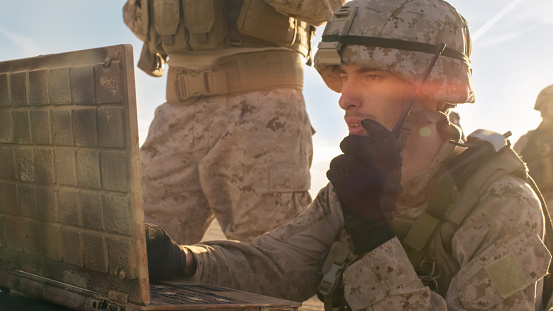
Traditional architectures send data back to distant servers for processing, a process that simply doesn’t work in degraded or denied conditions. Whether at sea in hostile waters or operating in terrain without a reliable uplink, waiting for data to be processed elsewhere can delay mission-critical decisions.
That’s not an option when time is limited and stakes are high. It’s here where edge computing can truly close the gap.
By enabling local data analysis, this modern practice reduces dependency on backhaul infrastructure and preserves bandwidth for essential transmissions. This ensures:
- Real-time situational awareness and decision-making
- Operational continuity in DDIL (denied, degraded, intermittent and limited-bandwidth) environments
- Improved autonomy for warfighters in the field
At Atlas Tech, enabling this transformation is more than a technical objective. It’s a core part of our mission-driven innovation. Supporting the Department of War’s vision for Joint All-Domain Command and Control (JADC2), Atlas delivers resilient, tactical communications systems and AI/ML-powered applications that ensure the mission continues, even when the network doesn’t. From afloat operations to mobile ashore systems, our solutions connect forces across domains with speed, precision and reliability.
Data Defense Solutions Built for a Tactical Edge
Atlas Tech has spent decades supporting resilient communications for the Department of War (formerly Department of Defense)and Department of Homeland Security (DHS), specifically in environments where edge performance isn’t optional. It’s operational.
Our platforms are engineered for denied, degraded, disrupted and austere (DDDA) conditions. Now, we’re leading data readiness with AI/ML-enabled applications that bring intelligent support to the tactical edge. From predictive analytics that monitor equipment health and flag anomalies early to on-site support tools that enable strategic decisions in real time, Atlas Tech is actively developing solutions that arm warfighters with insights, automation and predictive support directly at the point of need.
How Edge Computing Works with AI
When edge computing and AI/ML come together, they create a true force multiplier. What does this mean for the modern warfighter?
- Faster insights: Algorithms analyze data locally and instantaneously.
- Enhanced autonomy: Units can operate intelligently with minimal external inputs.
- Improved resilience: Decisions don’t stall when links are down or latency spikes.
This makes every sensor smarter, every vehicle more responsive and every warfighter better equipped. Tactical units don’t just collect data; they interpret and act on it in the moment. That can make the difference between success and setback on the battlefield..
Engineering Through the Challenges at Atlas Tech
Delivering edge capability isn’t easy, which is precisely why Atlas Tech stands out. It’s not about slapping a rugged case on a laptop. It’s about building something reliable, intelligent and field-ready from the start.
Our edge platforms are purpose-built to operate in austere, space-constrained and power-limited environments. Whether integrated into a vehicle’s onboard mission system or deployed from a rucksack in the field, Atlas ensures that SWaP optimization never comes at the cost of performance or resilience. Each subsystem and component is selected for mission suitability, environmental tolerance and sustainment under operational loads.
Security is architected in from inception. Atlas applies a defense-in-depth approach, layering encryption at rest and in transit, enforcing strict access controls, and using zero-trust and hardened firmware architectures that maintain data integrity and system assurance even when disconnected from enterprise networks or operating in contested domains.
Integration is fundamental, not optional. Atlas Tech edge systems are designed for interoperability, leveraging open architectures, modular hardware and standards-based interfaces to ensure seamless integration with legacy platforms, Joint All-Domain Command and Control (JADC2) environments, and coalition networks.
Reliability is engineered, not assumed. Atlas edge systems are qualified to MIL-STD-810 and MIL-STD-461 methodologies, ensuring operational effectiveness across extremes of temperature, vibration, shock and humidity. Each system is field-maintainable with firmware that can be securely updated in-theater and hardware ruggedized for impact and moisture exposure. If it cannot withstand a hard landing, salt fog or thermal shock, it does not ship.
These aren’t just engineering goals. They’re expectations from the warfighters we serve. And they guide every build, test and deployment.
A Partner for the Future
From predictive AI analytics to resilient, deployable comms systems, we’re committed to developing technologies that meet real-world operational needs. Our work is grounded in field experience, tested in DDDA conditions and aligned with national security priorities.
Looking for a partner who understands the edge and how to push it further? Or a career where your work directly empowers U.S. military readiness? Contact us today.